(BevMo Pasadena, April 2011)
Jones Soda Co. is an interesting animal in the soft drink menagerie. The company started as the Urban Juice and Soda Company in 1987 primarily as a beverage distributer in Western Canada, expanding to cover much of the Pacific Northwest before moving their base of operations to Seattle. While they did start creating their own products in the mid-1990s – including the Jones Soda line for which the company is now named – I wouldn’t necessarily call them a regional brand, since regional brands typically have fairly small spheres of influence. Although Jones’ “alternative” marketing strategy for their sodas stayed out of the mainstream – they sold almost exclusively in board shops, tattoo parlors, and clothing and music stores – their bread-and-butter distribution operation moved products like AriZona Iced Tea all over the country. Eventually Jones Sodas started popping up in Starbucks, Panera Breads, and stores of similar ilk, and for a time was even the exclusive beverage vendor for the Seattle Seahawks. So they managed to become sort of a big, expensive fancy-pants kind of soda company, while still trying hard to look like an obscure little guy on the drink radar (one of their slogans is “run with the little guy”).
I guess you could say that makes Jones the hipster of the soda world. Sure, it might want you to believe it only engages in commerce with local mom-and-pop shops, eats from the farmers market’s offerings, shuns brand-name clothes, and spends its weekends meditating in various yoga poses, but in reality, it drives a $40K European car, works for a mega-chain investment broker, and overspends its disposable income crowding into dimly lit indie music venues that feature unique acts that sound exactly the same as those other unique acts playing in the ten other virtually identical dimly-lit indie music venues down the street (that's right Los Feliz, I'm talking about you).
What were we talking about? Ah, yes, root beer. Jones Root beer tastes like … marshmallows… Big, fluffy, jet-puffed marshmallows. Don’t get me wrong – I like marshmallows as much as the next guy, but until they make root beer marshmallows, my root beer should not taste like marshmallows. And I think I just typed the word ”marshmallows” more times in this paragraph than I have in the previous five years of my life. The flavor is almost holiday-ish to me, possibly because it reminds me a little of the frosting we used to use as children to assemble gingerbread houses. Since Jones uses inverted sugar – a type of sugar typically used in gummy candies and the like because it remains in a more liquid state without crystallizing like regular sugar – I would have expected a fuller texture. Maybe I was expecting the inverted sugar to give off more honey-like properties, since honey may be considered by some as a form of inverted sugar, but the texture was rather uninspiring as well.
Yeah, so Jones Root Beer smells a little like root beer when you first open the bottle, but that’s where the root beer side of things ends. Jones gets a 1.5.
It's stark! It's raving! It's blogging! And it probably doesn't make any sense... Now with rooty tooty sugary beverages! But it still probably doesn't make any sense....
Wednesday, April 27, 2011
Thomas Kemper Purely Natural
(Grassroots Market – South Pasadena, March 2011)
Seeing as I’ve already posted about IBC, Weinhard’s, and Stewart’s, you may have wondered,
Hypothetically speaking though, assuming anyone is reading, and assuming those hypothetical readers are asking the question above, here’s my not-so-hypothetical-and-somewhat-measured answer: I simply don’t like Thomas Kemper Root Beer. To be fair to Mr. Kemper, I haven’t had any of his root beer in recent memory. But to be fair to myself, I haven’t had any recently because I’ve had it several times in the past and I know I didn’t like it any of those times. I may yet dip into the Kemper keg once more for the sake of cataloging the experience in the interests of science (with a lowercase “s” as opposed to, you know, SCIENCE!), but I will wait until I’ve exhausted all other root beer resources in my little corner of the world until doing so. Still, that means I’m willing to give it a chance, right?
And so this is the story of how I came to acquire a bottle of Thomas Kemper Purely Natural Root Beer – proof positive that I am willing to give Tommy Boy a fair chance at making a good second impression (or fifth or sixth, as the case may be). There isn’t much of a story, actually; I just happened to walk into a local health food store I never noticed before while en route to my normal chain grocery store – that is, the store where normal Thomas Kemper sodas are available – and noticed this in the refrigerated soda display next to maybe a hundred different variations of bottled kombucha tea (ok, I exaggerate; maybe only 90 variations). I picked it up apprehensively, given my relationship history with Tom up to this point, paid my money to the nice lady behind the counter, and proceeded to conduct my commerce at the evil produce conglomerate next door. Um… end of story …
Moral of the story: fool me once… I am vindicated in my disdain of The Kemp’s root beers, because this is one of the worst root beers I’ve had in recent memory. Thomas Kemper Purely Natural Root Beer is thin and watery, with an only slightly root-y flavor – that’s the good news. Said slight root-y flavor is easily overwhelmed by the bitter sting that lingers on the back of the tongue. Honey is listed with the ingredients, which may account for some of the thickness in the texture, but the texture is hardly smooth and the honey flavor is non-existent – in fact, it tastes slightly salty. Drinking this is downright unpleasant to the point that I can’t finish it. According to the label, “Only Thomas Kemper could brew a handcrafted root beer so natural & delicious,” but this should really be revised to read, “Only Thomas Kemper could brew swill so awful and try to convince you that it’s root beer.”
Seriously, I think I liked TK better before he got all granola on us – which doesn’t even make sense since the “natural” ingredients aren’t even that different from the normal ingredients. That’s like telling me you’re adopting a healthier lifestyle when all you changed was the shampoo you use every morning. Kempy, I am disappoint. If I can’t even finish it, you get a 0.5.
Seeing as I’ve already posted about IBC, Weinhard’s, and Stewart’s, you may have wondered,
"Why haven’t you posted about the last of the 4 bottled root beers easily available at the local grocer? You know, Thomas Kemper?”But who am I kidding – you wouldn’t be asking because nobody is reading this drivel anyways…
Hypothetically speaking though, assuming anyone is reading, and assuming those hypothetical readers are asking the question above, here’s my not-so-hypothetical-and-somewhat-measured answer: I simply don’t like Thomas Kemper Root Beer. To be fair to Mr. Kemper, I haven’t had any of his root beer in recent memory. But to be fair to myself, I haven’t had any recently because I’ve had it several times in the past and I know I didn’t like it any of those times. I may yet dip into the Kemper keg once more for the sake of cataloging the experience in the interests of science (with a lowercase “s” as opposed to, you know, SCIENCE!), but I will wait until I’ve exhausted all other root beer resources in my little corner of the world until doing so. Still, that means I’m willing to give it a chance, right?
And so this is the story of how I came to acquire a bottle of Thomas Kemper Purely Natural Root Beer – proof positive that I am willing to give Tommy Boy a fair chance at making a good second impression (or fifth or sixth, as the case may be). There isn’t much of a story, actually; I just happened to walk into a local health food store I never noticed before while en route to my normal chain grocery store – that is, the store where normal Thomas Kemper sodas are available – and noticed this in the refrigerated soda display next to maybe a hundred different variations of bottled kombucha tea (ok, I exaggerate; maybe only 90 variations). I picked it up apprehensively, given my relationship history with Tom up to this point, paid my money to the nice lady behind the counter, and proceeded to conduct my commerce at the evil produce conglomerate next door. Um… end of story …
Moral of the story: fool me once… I am vindicated in my disdain of The Kemp’s root beers, because this is one of the worst root beers I’ve had in recent memory. Thomas Kemper Purely Natural Root Beer is thin and watery, with an only slightly root-y flavor – that’s the good news. Said slight root-y flavor is easily overwhelmed by the bitter sting that lingers on the back of the tongue. Honey is listed with the ingredients, which may account for some of the thickness in the texture, but the texture is hardly smooth and the honey flavor is non-existent – in fact, it tastes slightly salty. Drinking this is downright unpleasant to the point that I can’t finish it. According to the label, “Only Thomas Kemper could brew a handcrafted root beer so natural & delicious,” but this should really be revised to read, “Only Thomas Kemper could brew swill so awful and try to convince you that it’s root beer.”
Seriously, I think I liked TK better before he got all granola on us – which doesn’t even make sense since the “natural” ingredients aren’t even that different from the normal ingredients. That’s like telling me you’re adopting a healthier lifestyle when all you changed was the shampoo you use every morning. Kempy, I am disappoint. If I can’t even finish it, you get a 0.5.
Friday, April 8, 2011
Steelhead
(Steelhead Brewing Co., Irvine, March 2011)
As promised in the previous posting, I now bring you Steelhead Root Beer. I first encountered Steelhead during a weekend jaunt up to Portland, OR for my best friend’s bachelor party. Being of the epicurean persuasion, our small traveling team basically only made plans to hit certain eateries while in port (land) (…sorry…), and then spend the rest of the weekend wandering around the city, seeing whatever we could in whatever time we had left (Voodoo Doughnuts, anyone?). Since we are also of the pastrami persuasion, we had planned well in advance to pay a visit to Portland’s premiere pastrami mavens at Kenny and Zuke’s Delicatessen, and it was at this auspicious location that I both discovered Steelhead Root Beer and was inspired to such verse as to garner praise and smoked meat, as evidenced in my previous posting (i.e., the Haiku that resulted in 2 lbs of brisket being shipped 1,000 mi to my door).
My initial intent was to bring the Steelhead home, where it could be evaluated in the same controlled environment in which every other brew is scrutinized for this fair webpage, but in my enthusiasm, I had lost sight of the Transportation Security Administration, and their prohibition of liquid carry-on luggage. Since it did not seem worth the hassle of checking my one piece of baggage (well, at least physical baggage) for the sake of some soda, I opted to drink all of them before I left. Bear in mind that this included not only the Steelhead, but a couple different fruit sodas I was planning on bringing back for the missus… Thus, my first taste of Steelhead occurred on a railway platform, as I was awaiting the train that would take my fellow travelers and me back to the airport. And you know what? It was good! Certainly a nice way to cap off the weekend trip.
Fast forward a little less than a year later, when Steelhead Root Beer and I meet again. Now I do recall my other best friend saying something to the effect of, “Isn’t this stuff from Irvine?” when I first picked up the bottle from Kenny and Zuke’s, but all I cared to see on the label back then was that it was from Eugene, OR – close enough to Portland to call it a local brew (And why not? Portland is known for their local micro-breweries, so why not partake of some local root beers as well? Incidentally, I did have a couple of brewery-crafted root beers that weekend, some of which were better than others. Deschutes Brewery & Public House makes a good one – even if their burgers were sub-par – and Rock Bottom Restaurant & Brewery makes a not-so-good one – it was served to me somewhat warm and somewhat flat.). As it happens, my buddy was right – he lives less than 2 miles from the Irvine branch of the Steelhead Brewing Company. Rather than feel silly for trying to transport a bottle 15 times farther than I really needed to, I shall choose instead to revel in the opportunity to renew my acquaintance with Steelhead.
Steelhead certainly lives up to the bartender’s description: honey and vanilla. The initial scent is herb-y, rounded out with a strong whiff of vanilla. Flavor-wise, the honey arrives first, but doesn’t come on so strong as to overpower the herbs, as I can taste the licorice and birch accents. An almost clove-ish essence finishes the aftertaste, leaving a clean herby palette. Overall, the blend of flavors is good, if a bit mild in the root category, and the honey really richens the flavor in addition to smoothing out the texture (and it is very smooth), as you would expect from honey. Carbonation isn’t too strong, but generally with the richer, smoother root beers, you expect more head/foam than bubbles, so it works well in this respect.
The Steelhead Brewing Company also makes a second, draught-style root beer strictly for their bar. While one can easily acquire this brew, one must be willing to acquire it a gallon at a time, since it’s only sold in a gallon box (they won’t fill their growlers with root beer apparently… I vow to test their resolve in this matter at a later occasion.). Normally, I am not one to shy away from a drinking a gallon of root beer, but seeing as I would have had to leave the root beer in my car for a significant period of time before it reached a cooler, I opted not to partake at this time so as to prevent any loss of freshness, and thus cloud my perceptions of their tap brew. The bartender was kind enough to offer me a small sample of their second root beer, and I will say it does taste different – less sweet, with more pronounced licorice and birch accents. Granted, this was based on really only having two sips of it. My guess is that I will like it better than the bottled honey-vanilla variety, since my preferences generally lean more towards the birch end and less towards the sweeter end of root beers anyways – again, we will see next time I go back.
That having been said, we now hit the inherent-fallacy wall of subjective reviews. Steelhead’s website states that their root beer is identical to their sister brand, Bulldog Root Beer. If you recall, I gave Bulldog a 3.5 – a high 3.5, but a 3.5 nevertheless. So I ask now, can our perceptions of flavor be influenced by the myriad of environmental factors surrounding our experience of that flavor? My feeling, this time around, is that Steelhead has a stronger honey flavor than Bulldog, but not in a bad way. Texture feels fairly similar, but there seemed to be a slightly stronger herb flavor in the Steelhead, so I want to say I like the Steelhead better than the Bulldog. But I have to ask – do I prefer the Steelhead just because of my first experience with it? I have good memories of that trip, so having the Steelhead around reminds me of those good times. Also, it doesn’t hurt that I had some Kenny and Zuke’s pastrami to accompany some of my Steelhead (though I did not have any pastrami prior to drinking the Steelhead for the purposes of evaluation, since I know that can affect the perception – I did have some Wilging’s salami maybe an hour beforehand, which may have skewed my judgment slightly, as we’ve established that salami can make root beer taste slightly more wintergreen than it would otherwise, which may account for my determination that Steelhead is herb-ier than Bulldog. An hour before though, so I don’t know how long that lingers, particularly since I made sure to eat something else afterwards to neutralize my palette).
Still, I’ve never made any claims to objectivity, and very much to the contrary have repeatedly espoused my subjectivity. Thus pending a SCIENCE(!)tific comparison (which I promise is coming), I will stand by my assessment for now – I give Steelhead Root Beer a solid 4.
(In case you’re wondering: steelhead is a type of trout – genetically identical to rainbow trout, except whereas a “normal” rainbow trout lives in freshwater, a steelhead lives in the sea and only returns to freshwater to spawn. That is, it is an anadromous fish, and is actually closer in species to Pacific salmon than it is to typical brown trout. As to why Steelhead Root Beer is named for a salmonid trout, I can only speculate that steelhead spawn in Eugene, OR, where the Steelhead Brewing Company was founded – again, this is only speculation.)
Wednesday, March 23, 2011
The Package
So a couple weeks ago, this slightly dinged up box showed up on my doorstep:

Not one to regularly receive parcels, I glanced at the sender.

What could possibly be inside?? Um... Instructions, apparently...

Just slightly south of the instructions, we hit the mother lode.

For interested parties, here's the line-up, diagrammed:

The Pooj can barely contain himself, marveling at the bounty before him.

Being a smart creature, the Pooj makes a grab for the good stuff.

And we dress it up formally with some homemade slaw and melted Swiss for a proper dinner party.

The Steelhead seemed an appropriate dinner guest, seeing as I first became acquainted with Steelhead at my last visit to Kenny & Zuke's kitchen. More on the Steelhead in a later post.
A million thanks to the great people at Kenny & Zuke's and the fine folks at Serious Eats for providing the feast!
For the full story, check this out.
Not one to regularly receive parcels, I glanced at the sender.
What could possibly be inside?? Um... Instructions, apparently...
Just slightly south of the instructions, we hit the mother lode.
For interested parties, here's the line-up, diagrammed:

The Pooj can barely contain himself, marveling at the bounty before him.
Being a smart creature, the Pooj makes a grab for the good stuff.
And we dress it up formally with some homemade slaw and melted Swiss for a proper dinner party.
The Steelhead seemed an appropriate dinner guest, seeing as I first became acquainted with Steelhead at my last visit to Kenny & Zuke's kitchen. More on the Steelhead in a later post.
A million thanks to the great people at Kenny & Zuke's and the fine folks at Serious Eats for providing the feast!
For the full story, check this out.
Thursday, March 17, 2011
Johnnie Ryan
(Rocket Fizz Ventura, February 2011)
Just in time for St. Patrick’s Day, we present Johnnie Ryan Root Beer. Apparently, Johnnie Ryan Beverages was originally the Keystone Water Company at its inception 1934, and later the Extra Bottling Company in 1935, finally settling on their current name in 1942 because the owners thought that having an Irish-sounding name would attract more business. They also apparently have as many logos and slogans as they do company names: logo-wise, there’s some sort of crest/shield/crown/horses thing on the front, and a top hat and cane on the neck/cap/back; slogan-wise, they are “First for Thirst,” a “Real Refresher,” and also a “Family Favorite.” So apparently they are multi-cultural, of good pedigree, rather dapper, and somewhat schizophrenic…
However you spin it and whatever you call it, though, they certainly make a dang good root beer. All the requisite root beer flavors are there – sassafras, birch, licorice, and then some – and blend together quite well in the initial taste. It’s just sweet enough to not fight with the herbs and still keep the overall beverage from being bitter. There’s also a good root-y smell with hints of vanilla, and a slightly clove-y aftertaste that lingers for a bit longer. On top of that, the carbonation is just right to give a good fizz without masking flavor.
Good show, Johnnie Ryan – I give it a high 4.
*Johnnie Ryan = John Ryan = John Patrick Ryan = Tom Clancy’s Patriot Games = Get it? Nevermind.
Friday, March 11, 2011
Old Town
(Cost Plus World Market, January 2011)
If your store is called the Old Town Root Beer Company, I say you’d better make a good house root beer – otherwise just close down shop and go home. That having been said, I actually did not find Old Town Root Beer at an Old Town Root Beer Company store, so one way or the other, I don’t expect the owners of that store to close down and go home. For that matter, I don’t expect the Old Town Root Beer Company to do so either – quite the contrary, I hope they have a long and fruitful life, because they make quite a good house-brand root beer!
Old Town uses honey very well as a secondary sweetener – it smoothes out the texture and adds a nice flavor that does not overpower the herbs like honey has a tendency to do. The rest of the flavors blend together very well to give a good root-y initial taste that continues to build as you drink more of it. Although cane sugar is the main sweetener, it does not detract from the herb flavors like it can in other root beers. Many of these other root beers hit you first with a heavy sweetness that only fades into root-iness. It’s actually the other way around here – Old Town hits you with a nice rich root-iness, with the sweetness following through with the aftertaste. Even then, the aftertaste is refreshingly herb-y.
Bravo to Old Town Root Beer Company for making their namesake beverage proud. Now all I have to do is find one of their stores and get some from the draught… Old Town gets a high 4.
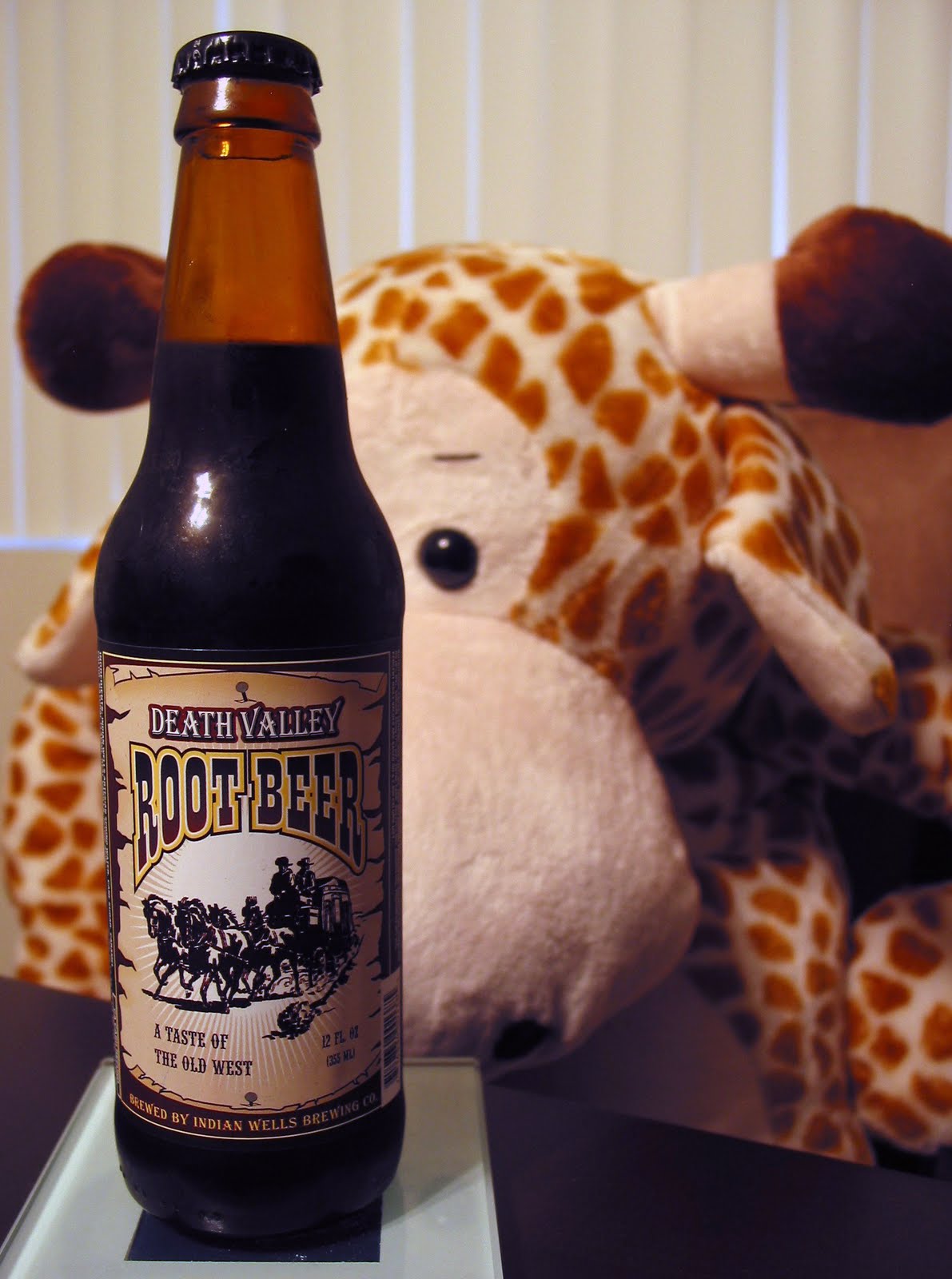
Death Valley
Here’s an interesting question: does better water make better root beer?
Death Valley Root Beer is made from natural artesian water from the Indian Wells Spring here in my home state of California (not too far from Death Valley, for which this brew is named). I don’t usually pay much heed to craze for “natural” bottled waters, since paying heed usually entails paying money for what I can essentially get out of the kitchen tap. Despite what some people insist, once you pass that stuff through a Brita filter, in most cases I can’t taste the difference between tap water and bottled water (I can, however, state that there are several bottled waters that taste like they were scooped out of my neighbor’s swimming pool…). You would think that once the water, wherever it is sourced, gets brewed into a nice root-y beverage and gets shot with some carbonation, virtually any taste difference in the water would, pardon the pun, evaporate. So it is with Death Valley Root Beer.
Now that’s not to say I didn’t like the root beer, because I actually did like it. The carbonation is pretty hard from a freshly opened bottle, so that pretty much drowned out any flavors for the first few sips. Once I let the carbonation dissipate a little, the flavor becomes a much more pronounced licorice. As I continue to drink, the flavor builds into a nice rich herb-iness. There’s a noticeable lack of wintergreen in the initial flavor, possibly because it’s covered up by the strong licorice taste, but there’s more of the wintergreen in the aftertaste. The missus brushed her teeth prior to her sip, which in her opinion added some wintergreen essence, but since I did not mix my root beer with toothpaste (?!), I can’t say the same.
Overall, I still did like Death Valley – the flavor is rich, so perhaps the spring water does make a difference in flavor and texture (can't really say for sure...). But since I generally prefer a better balance of wintergreen to licorice, with even perhaps a little heavier of a wintergreen and sassafras flavor, it’s not one of my favorites. Nevertheless, Death Valley gets a high 3.5.
Subscribe to:
Posts (Atom)